Our first night in the camper was very comfortable. It got down to 60 degrees overnight, and I had to get up and turn off our battery-powered fans, which would prove invaluable later in the trip, and get out a warm blanket that I never thought we'd use. The night was comfortable but noisy. We were near some train tracks. The sound of the trains themselves weren't a problem, but the train horns sounded periodically through the night, and I didn't figure out what the horns were for until morning. It sounded like a safety horn at a rock quarry, and each time it sounded, I awaited the blast which never came. Even worse than the trains was the local rooster, which needed a good killing. Had I gotten up and retrieved my earplugs, things would have been better, but I never did. Regret!
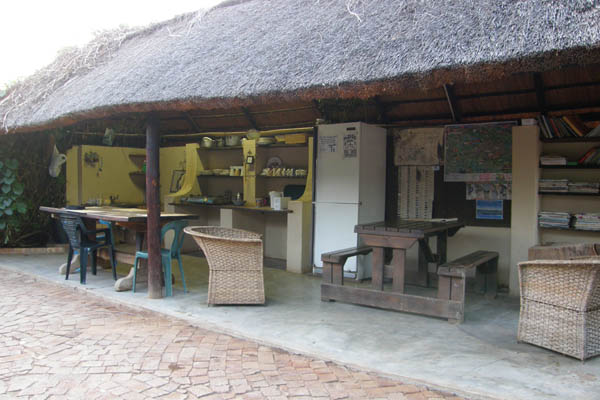
Camp Itumela has a thatch-roofed, outdoor, self-catering kitchen (with potable water), and I used their kettle for our first cup of coffee this a.m. Then the overlanders swarmed in and crowded us out, and we used the gas stove in the camper to heat our second cup. This morning, like most mornings of our trip, I had peanut butter and bread for breakfast with my Malarone anti-malaria pills, which must be taken with fat to be effective. I took my malaria meds in the a.m. and Tom took his in the p.m. so we wouldn't have side effects at the same time. The Malarone made Tom light-headed and woozy, and it gave me stomach trouble. But malaria is supposed to be a pretty rough business, so we kept taking the meds.
Self-catering kitchen, Camp Itumela
After breakfast, we scoured the campground and came up with a short length of electrical wire and rigged up a short-term fix to the problem of our stairs falling down. We'll see if it works! We left Camp Itumela and went into the town of Palapye. We struck out at finding a washer to fix the leaking sink, even though we stopped at a plumbing store, but we did find an ATM and got some more pula.
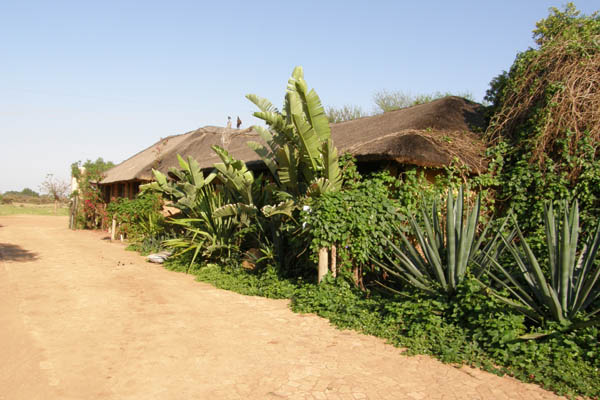
Camp Itumela, Palapye, Botswana
Tom did all of the driving yesterday, so today I had to help. This was very exciting for both of us, as I had approximately one hour of driving experience with a stick-shift previous to this, gained just two weeks earlier in anticipation our trip. After weeks of searching, we finally found a manual-transmission vehicle to borrow for me to learn on, which I practiced driving around the parking lot of the local high school. With that, I was no doubt well prepared for driving in Africa. On the left. I'd driven on the left in New Zealand, so at least that part wasn't completely new. There isn't much traffic on the highways of Botswana, thankfully, but the cows, goats, and donkeys constantly wandering into the road demand constant concentration. Anyway, except for occasionally shifting into 5th when I meant to shift into 3rd, I managed pretty well.
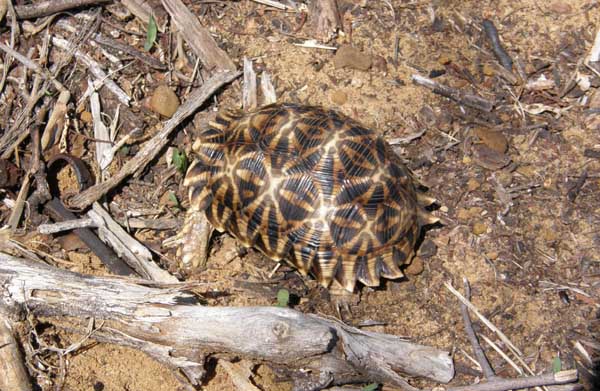
Bashful turtle, north of Serowe
The road we took from Palapye to Maun wasn't the most common route through Francistown and Nata, but the lightly used, recently paved road past Orapa and through Rakops. There was tons of livestock wandering in the road and quite a few donkey-drawn carts sharing the highway. Soon after we left Palapye, we saw our first monkey, and we had our eyes peeled for wildlife the rest of the day. We passed many rondovals (round huts). Then as we got further north, we started to see some of the rondovals surrounded by thorn bomas and high fences. Whether that's to keep out the wandering donkeys or more threatening wildlife I couldn't tell you.
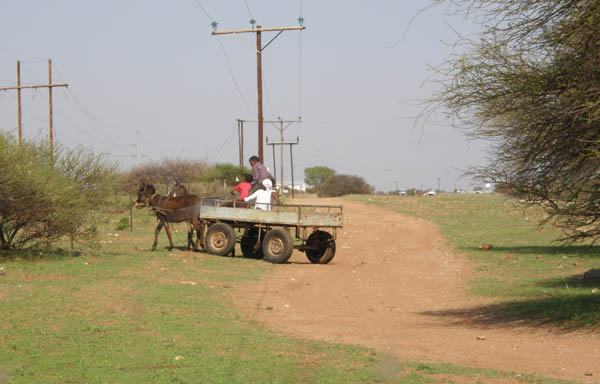
Uncooperative asses
There were four veterinary control checkpoints between Palapye and Maun. Sometimes at the checkpoints guards confiscate meat and dairy products to supposedly combat the spread of hoof and mouth disease, but that's generally for traffic going from north to south and not vice versa. At two of the checkpoints today the guards just waved us through, and at two of them the driver had to show a driver's license. It would have been helpful if our driver's licenses said "USA" on them and not just "Tennessee." We had to explain that we were from the United States, and that Tennessee is one of the states. Our driver's licenses actually say Tennessee's nickname of "Volunteers" as well, and the guard at one of the checkpoints thought we were with some kind of aid organization!
Botswana has the largest salt pans in the world, the result of an ancient evaporated lake. At Njare Pan, a small pan along the road between Orapa and Rakops, we turned on our GPS for the first time since leaving home, and it took over 15 minutes for the GPS to get over its confusion from having moved 9,000 miles since its last use.
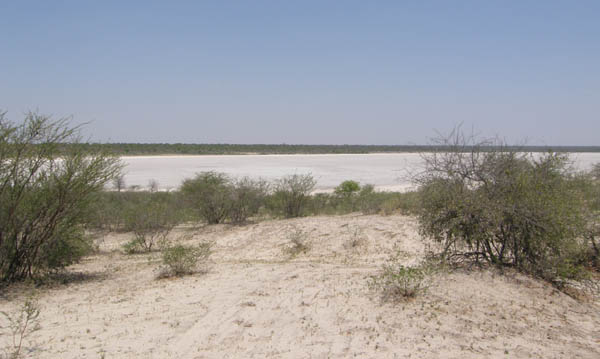
Njare Pan
At the time of its independence from Britain in September of 1966, in the entire country of Botswana, there was only 12 kilometers of paved road. Then in 1967 Botswana discovered diamonds in Orapa. Other mines followed. From 1966, Botswana has had the fastest growing economy in the world. But this diamond bonanza has a very short expected lifespan, perhaps another 30 years or so. They hope to make up for the lost diamond income with high-revenue, low-volume tourism.
Several times today we could see diamond mines from a distance, then we missed a turn by about a kilometer and ended up at a large gate guarding the closed-to-outsiders town of Orapa. This place looked like it had tighter security than the Pentagon. A new shift of workers was arriving by bus as we did a U-turn out of there and got back on track.
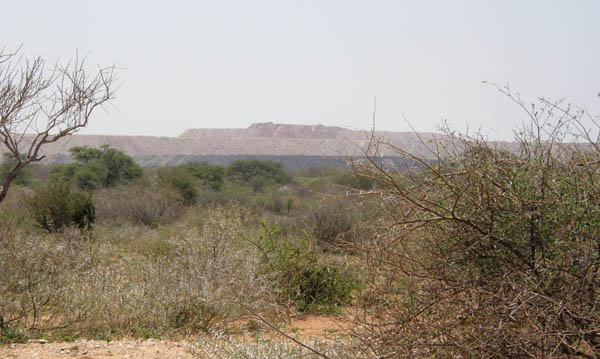
One of many large diamond mines in Botswana
Between Mopipi and Rakops several dust devils whirled their way across the flat, dry landscape. This part of the road has been paved for the first time fairly recently, and the cows and donkeys meandering about seemed a little surprised to see us.
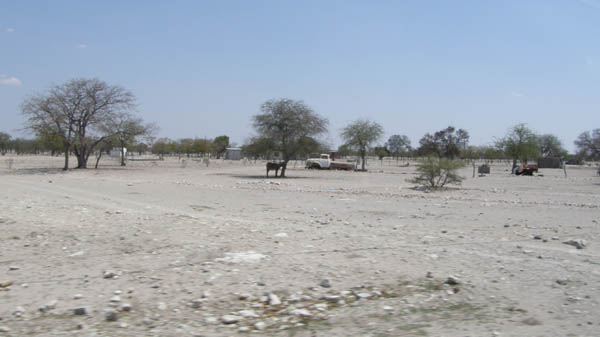
Alongside the road in Mopipi
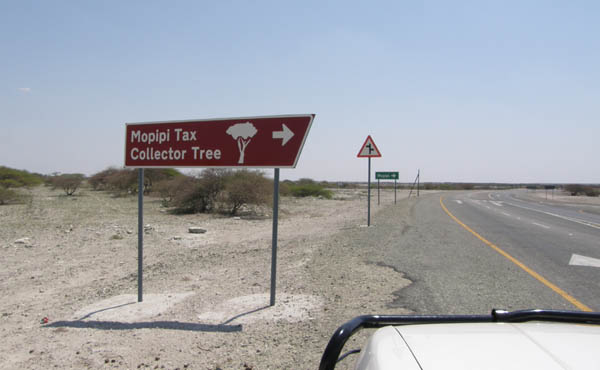
Tax collector tree? I'd say cut it down.
At Rakops we stopped and got a couple hundred pulas' worth of fuel, to be sure we'd have enough to get to Maun without fooling with the jerry cans. This is one of the very few places along this road where fuel is available.
An hour south of Maun, we saw two ostriches by the side of the road. To see them outside of a national park and just wandering around was too cool. I got a couple of decent photos, but when Tom tried to take a video, his video camera wouldn't work. Earlier, he'd charged his camera by plugging it into the cigarette lighter, and now it was fried. So no video for this trip. Bummer.
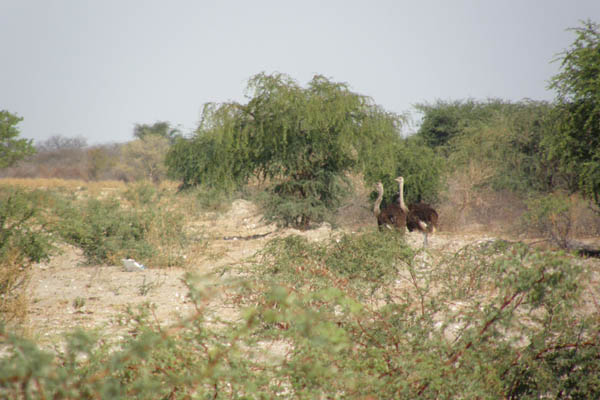
Our first ostriches
At 4:00 p.m. we arrived in Maun, the only town of note in this part of Botswana and the last place to get provisions before heading out into the bush. We needed enough food, water, and gas to last until reaching Kasane in five days.
The first grocery store we tried was closed for inventory; consequently, the next store was packed. I hadn't planned ahead what food to buy because I didn't know what would be available, but there was a pretty wide selection. We got steak, bacon, lunch meat, cheese, bread, bell peppers, potato chips, etcetera. Oh, yeah, and lots of water.
Once again we tried to find a washer for the camper's leaky sink, with no luck. Then we tried to use the Internet, but the Internet place we saw was closed. The national parks office closed early today because it's Sunday, so we'll have to go there tomorrow morning. With nothing more we could accomplish this afternoon, we topped off with gas and found a campground for the night.
Maun Rest Camp is an idyllic, no-frills campground just outside of town on the bank of the Thamalakane River. There's no bar at this one, just campsites and an ablution block (toilets and showers). It was nice and peaceful. After last night's trains and rooster, I needed some quiet. We got to the gate just before dark, and a gentleman emerged from somewhere and let us in. He said to claim any site we liked and pay in the morning.
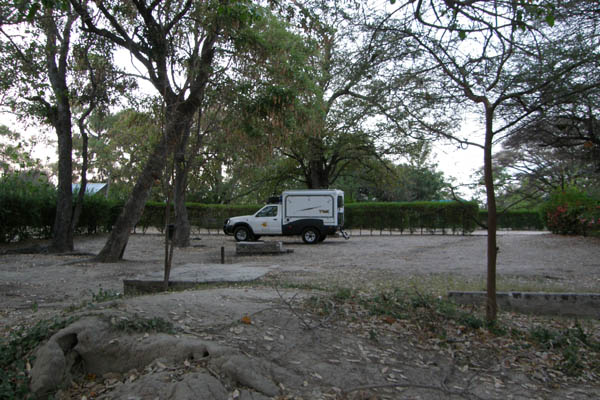
Giant camping pitch, Maun Rest Camp
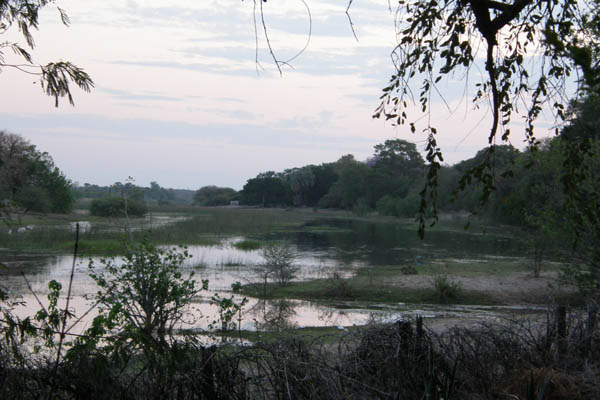
The view from our campsite
I fried up dinner on the camper's gas stove, delicious strips of steak and yellow bell pepper, served with fresh bakery bread. We'd skipped lunch, and Tom was feeling pretty sick till he ate.
While we were eating, all the lights in the camper suddenly went out. The auxiliary battery, powering the camper equipment, was located in the camper under the bed. We traced the problem to water in the battery compartment, then found a LOT of excess water in the vehicle. This wasn't from the leaking sink, because we hadn't used it at all. This was a new problem. The excess water was hot, so it had to be from the water heater. For some reason it had drained. Tom shut off the water heater, and between that problem and the leaking sink, we ended up not using the camper's water for the duration of the trip. Nor did we have lights in the camper after this for the rest of the trip. From here on out, each night we set up camp and cooked dinner by headlamp.
Exhausted, we did the dishes, showered, and went to bed. Tom and I each shared our shower with a big, nasty spider, something we got used to over the next several days.
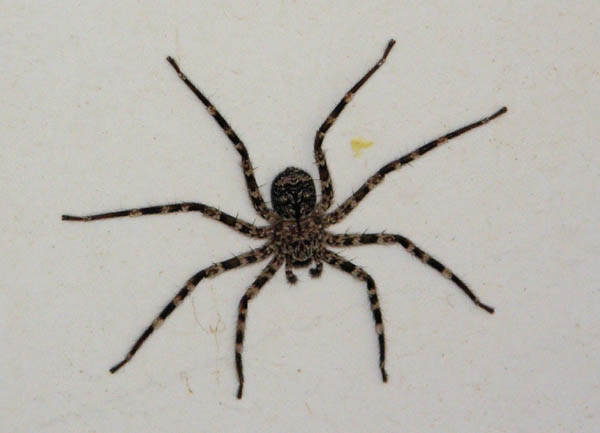
Shower buddy, Maun Rest Camp
612 kilometers Palapye to Maun.