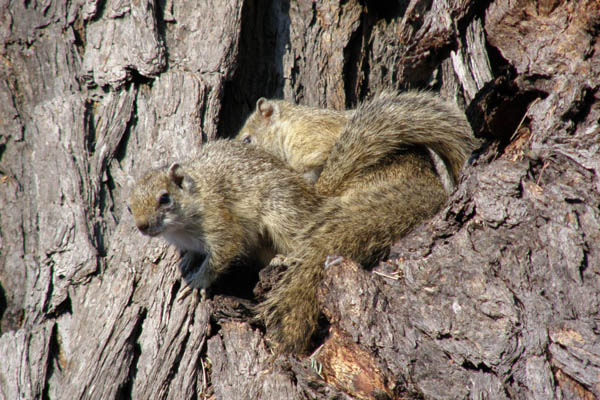
I got up at 5:00 a.m. to watch for wildlife. There were birds, squirrels, and lots of bottom-of-the-food-chain antelope, but again no cats. A couple of times I saw a lone, skittish antelope and thought sure a lion was going to come out of the bushes and pounce, but no such luck. I know the lions were around there somewhere. We could hear their cries during the night!
Cute little squirrels, Savuti
Before the South African group left, I gave Marilyn our Website address so they could check on us later and see if we survived. Hi, Marilyn! Hi, all!
At the entrance to the Savuti Campsite they have maps of the local area, but you have to know to ask for one. The South Africans gave us this info last night, so we picked up a map before heading out. We left camp and backtracked to Gobatsa Hill (Leopard Rock), a low, round hill a few kilometers to the south, before turning around and driving the 30km to the Ghoha Gate exit.
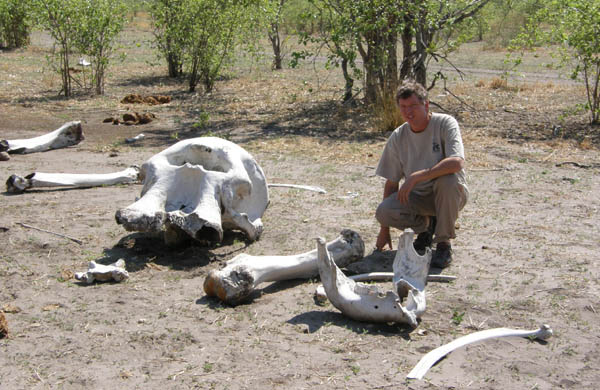
Let's get a present for Spike!
The track was pretty sandy at first, but as we neared the exit, part of the road was actually gravel. We didn't get too excited, though, because we'd been forewarned that the next 45km after the gate is horrendous. Appalled from the South Africans' description of the road, I'd scoured our books and maps and found a detour around the first 20km or so on a track that was supposed to be slightly less terrible.
We exited Chobe via the Ghoha Gate at 10:30, signing out in their book and showing all the official bits of paper proving we'd already paid on our way into the park yesterday. Tom asked the guard about the detour, and she confirmed it was the thing to do, as the main track was very sandy and churned up by lorries. So just past the gate, we made a 90-degree turn to the left, drove 7.5km, and made a hard right. If this was the detour, I'd hate to see the bad road.
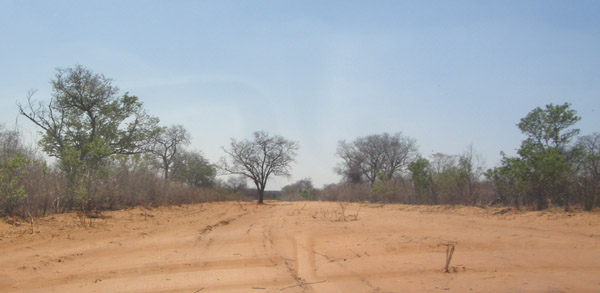
Road?
After the hard right, we plowed and skidded and skated 42 additional kilometers through the rolling dunes. The detour track meets up with and crosses the main track more than once. I think we managed to stay on the "better" track, the detour, the entire time, but I couldn't really see what difference it makes. When the "roads" ran parallel, they were virtually identical. It was the WORST ROAD OF ALL TIME. I know I said that about the road yesterday across the Magwikhwe Sand Ridge, but it's so hard to choose. Yesterday's track was probably slightly worse, but that was only 3km, while today's horrible road was ever so much longer. Either way, yuck. At one point we hit a large bump, nose-dived into the sand, and Tom bashed his head on the ceiling so hard I'm surprised he wasn't knocked out.
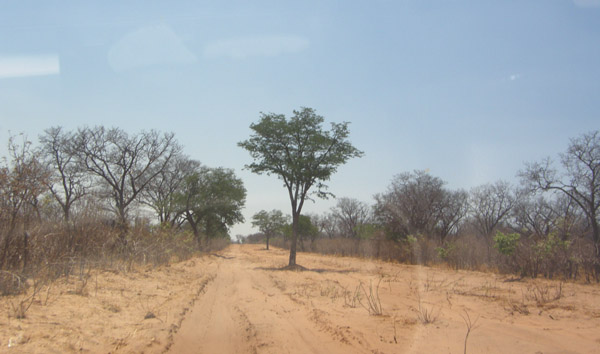
What road?
The track was deep, thick, silty sand. Tom did the driving, and I did the hanging on for dear life. I just kept thinking, "This is the road?????" These weren't national park tracks. This was an actual well-trodden path used by regular citizens (the few with vehicles) in northern Botswana. This is the road??? You gotta be kidding me. Tom's 4x4 driving had much improved in our last three days in the bush. The sand he drove us through yesterday and today was much deeper than the stuff we got stuck in for hours and hours on Monday.
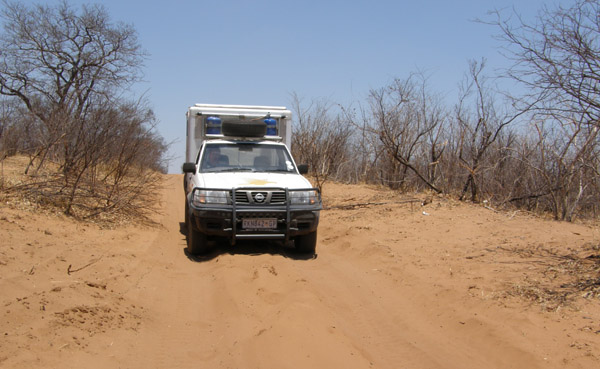
The rolling dunes of northern Botswana
In the village of Kachikau, the road finally turned to gravel, and we stopped and emptied our two reserve jerry cans of fuel, 40 liters total, into our gas tank and hoped it would be enough to last two more days in the bush, until we could fill up again. It bears repeating: There is no place to get fuel between Maun and Kasane. When we opened the cans, the contents were under pressure, and gas spewed all over my legs, and in a few minutes, it started burning my skin. I had to immediately shed my socks and take a wet-wipe bath right there on the side of the road - quite a spectacle for the local children who were just exiting the nearby school!
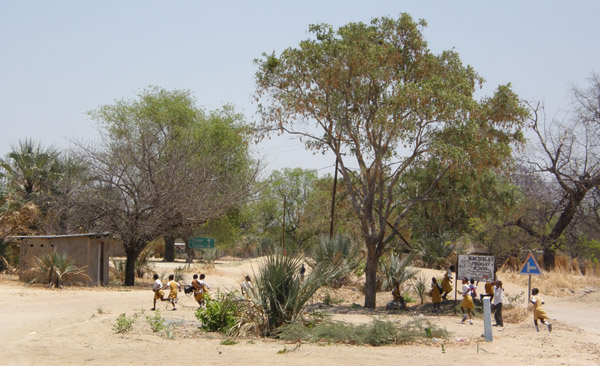
Kachikau, Botswana
Continuing north and east, there's a good view across the Chobe River into Namibia. Everything was green and lush here, a stark contrast to the dry sands of Savuti.
40km past Kachikau, I navigated us into a wrong turn and almost into Namibia. Tom flipped a U-turn, and we re-entered Chobe National Park at Ngoma Bridge. For once the guards didn't have us sign in, but they did check that we'd paid our Chobe entrance fees already. A sign posted inside the guard hut was full of helpful safety tips. We'd had a few kilometers of tar road just before the park entrance, but back in Chobe, the road turned silty again.
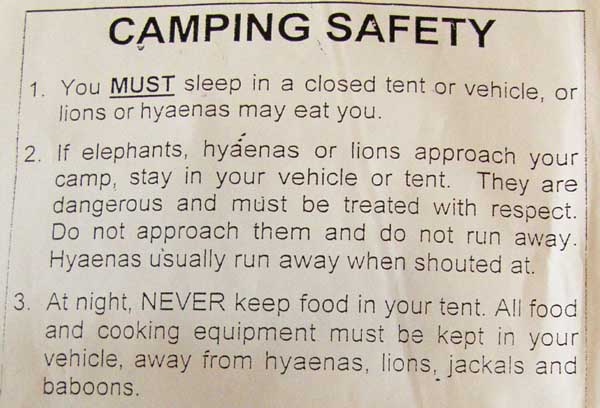
They don't sugar-coat it, do they?
The far northeast section of Chobe National Park along the Chobe River is referred to as the Serondela. This afternoon we slowly made our way from Ngoma Gate to Ihaha Camping Site, exploring the roads away from the river as well as the riverfront, looking for cats and other wildlife in every spot of shade.
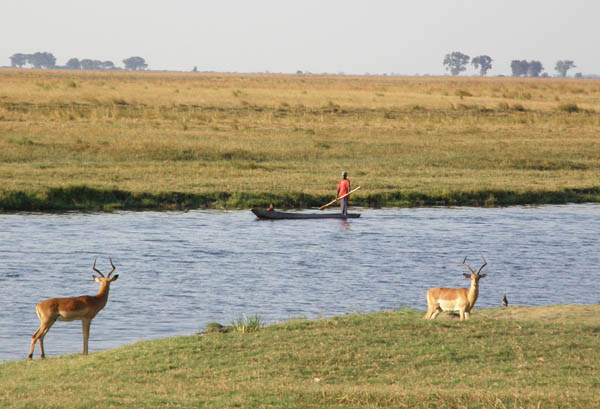
Mokoro dugout canoe, Chobe National Park
The riverfront was teeming with life: great herds of zebra, hippos, African buffalo, breeding herds of elephants numbering in the hundreds, antelopes, of course, and scores of warthogs. But still no cats. Where are the freaking cats??
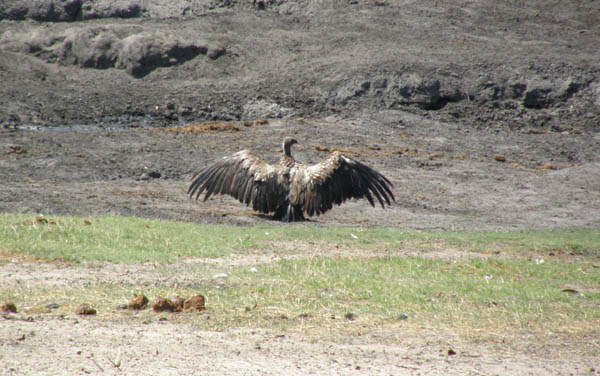
Getting warm in the sunshine
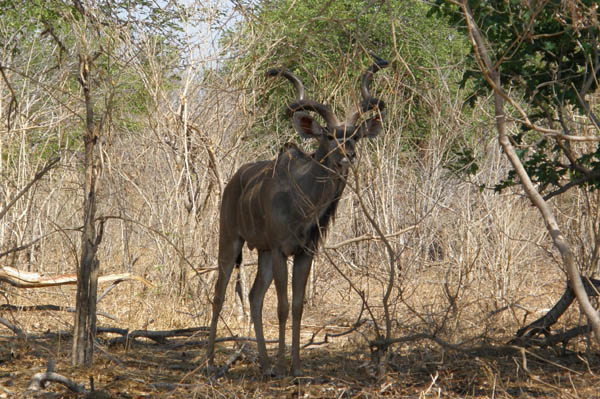
Kudu
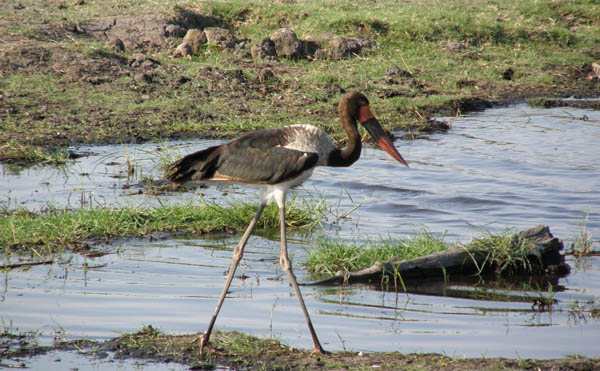
Saddle-billed stork
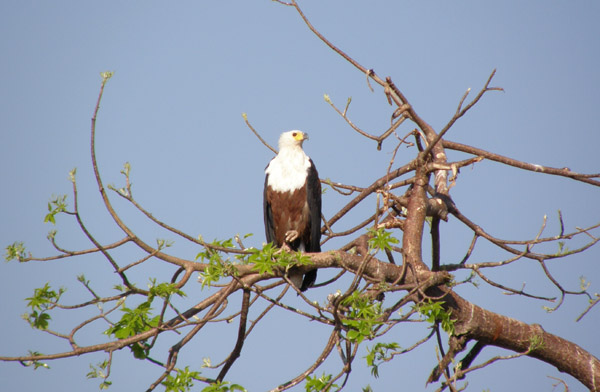
African fish eagle
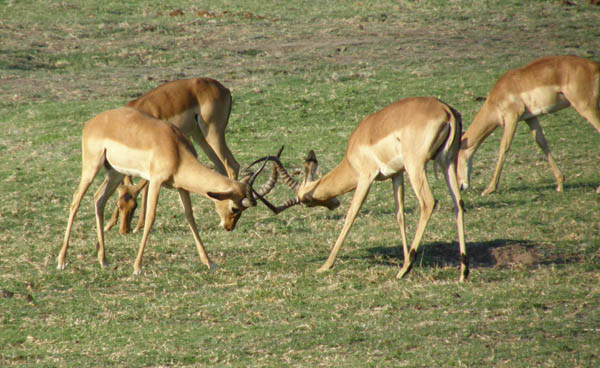
Crashing impalas
Around 5:00 p.m. we checked in at Ihaha Campsite. Like Savuti, and unlike Third Bridge and Xakanaxa, Ihaha had a game warden on site. The camp was fairly deserted, and the warden seemed happy when we showed up to have someone to talk to. We asked him about finding some cats, and he advised us, of course with no guarantees, to drive a few kilometers to the east just before sunset, staying next to the river, and that the lions might be out looking for dinner. Cool!
We quickly found our assigned campsite and threw out some chairs to be sure no one would jump our claim, but it probably wasn't necessary, because we had almost the entire campground of Ihaha to ourselves. Ihaha was our favorite camp of them all, with very private pitches overlooking the river, a nice fire pit, and a nearby water standpipe. Be warned, though: Lots of game comes through the campsites.
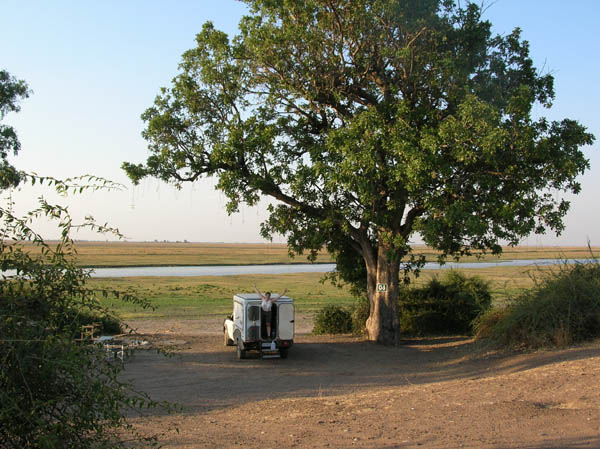
Jana claims Ihaha
After claiming our site, we drove 4km east to a lovely spot on the river to watch the sunset. A large herd of elephants with several babies was bathing in the Chobe. As the sun went down, as if on cue, the entire herd turned and left the river - and headed right for us! We were both standing beside the truck, and I jumped in the cab, as if that would protect me if an elephant decided to stomp. Just before the elephants reached us, they turned a bit to the right and safely passed by just a few meters from our bumper. It was the most memorable and awesome event of our trip!
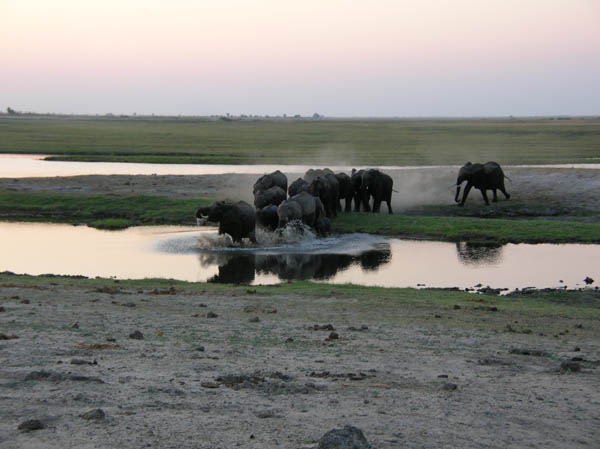
A breeding herd at sunset
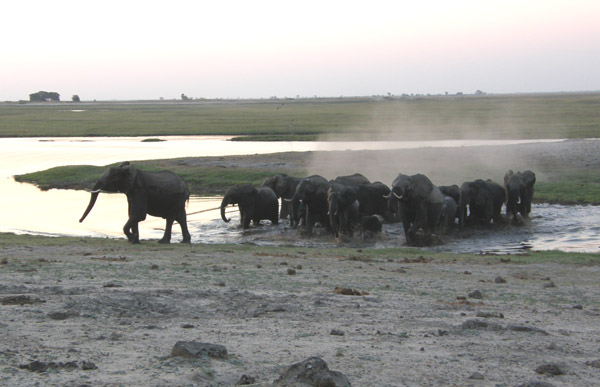
They're coming right for us!
Back at Ihaha just after dark, we decided to walk to the ablution block for showers instead of driving like we sometimes do, since we were relatively close. Driving to the ablutions, when it's done, isn't from laziness; it's to avoid encountering wild animals while on foot. We had our typical shower by flashlight then started to walk back to our campsite. Halfway there, we were stopped in our tracks by the sound of warthogs, a very aggressive animal, frighteningly close by. We couldn't see them, but I'm sure they could see us. We slowly made our way past, and the second we got back, Tom built a fire. This was probably the most dangerous event of our trip.
For dinner I fried up some bacon on the stove in the camper and served it with a hunk of bread and a hunk of cheddar. Good eats. If only we had some home-grown tomatoes! Tom found a piece of rebar here to substitute for the piece of wire that had been holding our back stairs together, a much sturdier substitute. We still had to wire the darn things into place while driving, though, making it a hassle to get into the back of the camper during the day.
We were sitting around the fire enjoying the sounds of the night, when all of a sudden we heard some animals fighting and running very close by. It sounded like they were running straight for our camp! We jumped into the camper and slammed the door quicker than you could believe. I don't know what it was, but it sounded like a couple of dogs fighting. Hyenas maybe? Jackals? We'll never know.
187 sandy kilometers Savuti to Ihaha, with extra game drives.