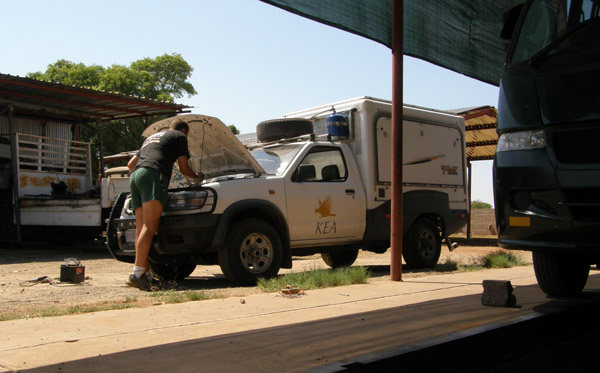
Our truck was due back at the rental depot outside Johannesburg tomorrow by 5:00 p.m., so we had two long days of driving ahead of us. Unfortunately, our early start was for naught when we only made it 3/4 of a kilometer from our lodge before we stalled and could not get restarted.
Besides the inconvenience, this was not the best place to be stranded. Lonely Planet says, "Don't walk from town to the falls as there have been a number of muggings along this stretch of road," and at the lodge, located between Livingstone and the falls, it was posted not to walk either direction as it was not safe due to muggings. Great.
Two young guys who had been walking by stopped and waited with us while we were stranded. I didn't know if they were there to help us or to rob us. I mean, can people who have nothing better to do on a Monday morning be up to any good? I was ready to pepper spray them at the slightest provocation. After the first hour, though, I gave up on them trying to mug us and was grateful for their company.
The truck has two batteries to give it enough juice to power the lights in the camper, which hadn't worked in a week, and the fridge, which gave out a day and a half ago. Since it was a standard transmission, we were able to push start it, but it would just stall again. It seemed the alternator was trying to charge both batteries at once, and it didn't have enough power. A passer-by even stopped and gave us a jump, but it just wouldn't work.
Eventually, we hailed a passing taxi, and I got a ride back to Maramba Lodge while Tom stayed with the truck. A manager from the lodge then gave me a ride to a mechanic, who sorted out a tow for us with a pickup truck, a metal bar, and some shackles. Once the mechanic had us to his shop, it only took him about 20 minutes to sort out the problem. He unhooked the second battery, replaced the 10-amp fuse that had blown two days before, and charged our main battery. That one little fuse had confused the entire electrical system, drained the battery, and wouldn't let it charge back up until the fuse was replaced. $75 later, at 10:30 a.m., after a three-hour ordeal, we were finally on our way and running very late.
Mechanical problems, Livingstone, Zambia
On the way to Kazungula there were two roadblocks. At the first they asked if we were headed for Botswana, and when we said yes, they collected a consul levy fee of 10,000 kwacha. At the second one they just waved us through.
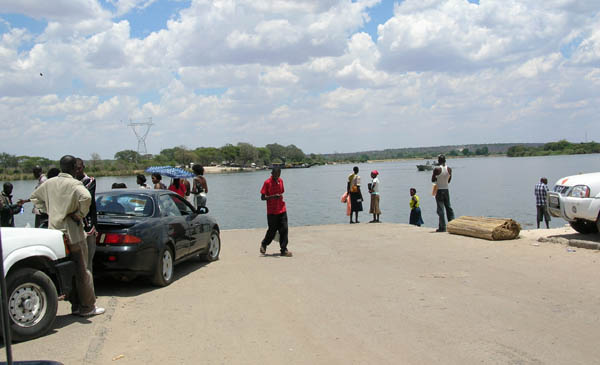
Waiting to cross the Zambezi River, Kazungula, Zambia
The passage back across the border at Kazungula was much easier traveling this direction, especially since we halfway knew what we were doing this time. The procedure is as follows:
- On the Zambia side, park wherever you can, giving some uninvited volunteer a small tip, if you must, to watch your vehicle.
- Go into the pontoon ferry payment office and pay for ferry passage. It was $20 for our Nissan hardbody pickup truck.
- Proceed to immigration, located in a different building, sign the book, and get your passport stamped.
- Proceed to customs and get a gate pass.
- Get back in your vehicle and drive up to the gate, hand over the gate pass which they will keep.
- Bypass the line of trucks and pull up to the ferry landing and wait.
A drunk and/or crazy guy tried to "help" us with ferry boarding. At first we gave him some of our paperwork, thinking he was some sort of official. He was not. At least he gave our paperwork back!
- Unlike when we crossed two days ago, this time when the ferry arrived, an official worker directed the vehicles on board. Two pickups drove on side by side, then a big cargo truck, then they managed to squeeze another pickup onboard, and then us. Our truck was precariously perched, but it worked.
- The passenger gets out of the vehicle before the driver loads the truck and boards the ferry with the other foot passengers.
- On board the ferry, the driver must show the receipt where ferry passage has been paid and sign the register.
- On the Botswana side, after the 400-meter ferry crossing is made, the driver unloads the vehicle, and the passenger walks off.
- Park wherever.
- Proceed to immigration, fill out their form, and get your passport stamped. They will give you a gate pass.
- Get customs to stamp your gate pass.
- The driver then goes to the cashier's window, just past customs. Here you pay a tax to get a road permit for the vehicle, 50 pula. We had to pay again even though we'd just paid when entering Botswana nine days before. You get a nice looking, very official permit, and I think they stamped the gate pass here also.
- Get back in your vehicle and proceed to the exit, where an officer will collect your gate pass.
- Drive through the dirty pool of disinfectant on your way out. This is a hoof-and-mouth disease control measure. Also, if they feel like it, officials will confiscate your meat and possibly dairy products for the same reason. No one questioned us about any meat, and we went on our way.
It was nice to be back in the seeming innocence of Botswana after the rat race of Zim/Zam. As soon as we left Kazungula, a baboon ran across the highway right in front of us. It was like coming home again!
By the time we crossed the border and filled up with gas, it was 1:10 p.m. We drove south like mad all day long. The first 100km is a good tar road, then south of Pandamatenga it got really rough, eventually smoothing out again as we got closer to Francistown. I did much of the driving today once we reached Botswana since I hadn't taken a turn at the wheel in over a week. Driving a stick-shift down a lightly traveled, paved highway isn't too bad.
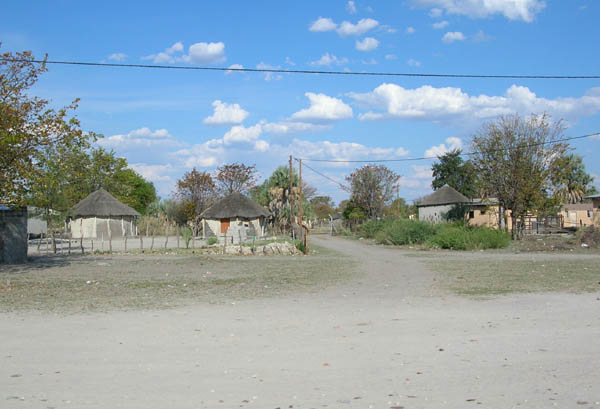
A village by the highway, Botswana
There were several vet control checkpoints throughout the day. At one of them we had to drive through dirty disinfectant again and stamp our shoes, including any extra pairs from our luggage, on a mat impregnated with disinfectant. Again, this is supposed to stop the spread of hoof and mouth disease. Also, at two of the checkpoints they were confiscating meat and dairy products, even crawling into the back of our camper to check our fridge, but with the fridge busted, we had nothing for them to take. It was kind of an ordeal for us, as it was a big production each time we had to unwire the back steps to open the back door, and one of us would try to stand in front of the missing taillight at all times to avoid unwanted scrutiny.
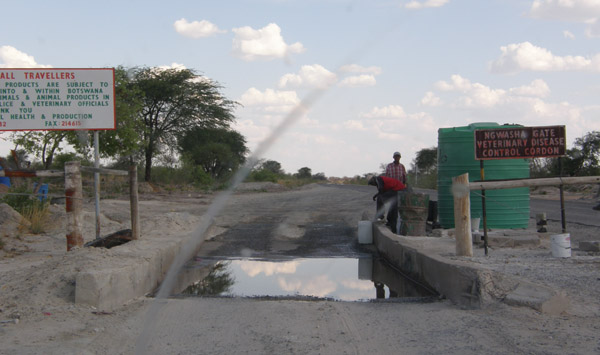
Ngwasha veterinary control point
Just north of the turnoff for Sebina, we stopped to take a photo of some interesting rocks, and a lady and her two daughters talked me out of 5 pula. Supposedly she lost her goat, and they're hungry, and they need a ride to their village, sob, sob, sob. Anyway, I'd taken a picture of her house, so I gave her the money.
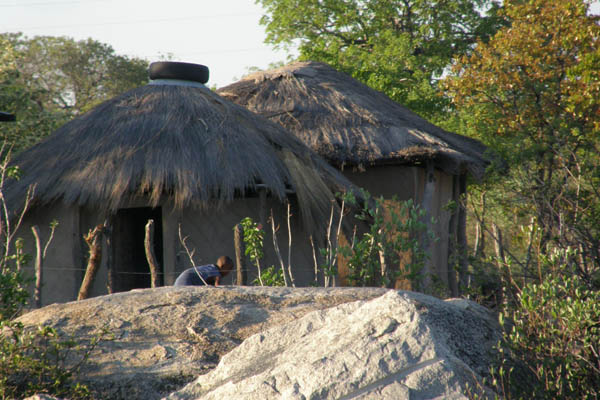
Typical Botswanan rondovals

North of Francistown
We'd hoped to make it to Palapye to spend the night at Camp Itumela again, like on our way north, but by the time we reached Francistown, it was almost dark, and we had to stop for the night. Francistown is Botswana's second largest city, population 95,000. The whole country has less than 2 million people. Compare to France, of a similar size, with over 60 million people, and you'll get an idea of how sparsely populated this place is.
I went into a Super-Spar to get groceries while Tom waited with the truck. Then we stopped at Marang Hotel to camp, highly recommended by our Lonely Planet guidebook. The camping was atrociously crowded, and try as we might, we could not wedge our truck in anywhere. So we moved on to Tati River Lodge, described in our book as lacking the character of Marang, and the place was fantastic. The receptionists were very cordial, a well-dressed bellman showed us to the camping sites, the ablutions were very clean, and the camping pitches were huge! When we got there, we had the camping ground completely to ourselves, then shortly afterwards, one other family arrived. Camping here was 40 pula per person, so 80 pula for the two of us.
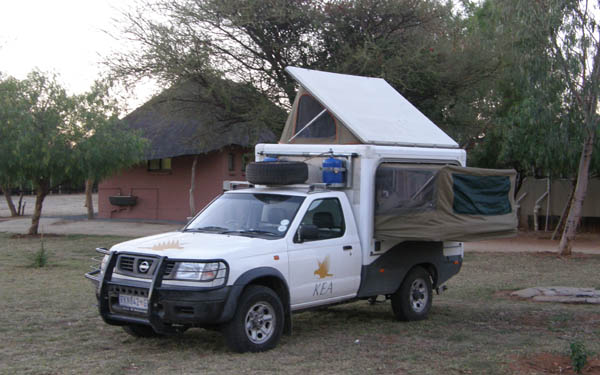
Tati River Lodge, Francistown, Botswana
For dinner I stir-fried a superior cut of steak and boiled an instant rice and vegetable mix that had the consistency of gruel but tasted decent enough.
580 kilometers Livingstone to Francistown.